Real Assistants in an Online World

Setting up Your Business on Facebook – the Right Way

Many small businesses have discovered the benefits of using Facebook to connect with their customers. Yet many of these same businesses have made a critical error in setting up their Facebook presence and as a result, run the risk of their presence being shut down for violating Facebook’s Terms of Service.

What is this common mistake? Setting up your business as a Profile instead of a Page or a Group. There are 2 easy ways to check:

  1. Do you have to log out of your personal profile and then log back in under your business email?
  2. When a non-friend or non-fan visits your Facebook profile or page, do they see an “Add Friend” button?

If either of these is true for your business presence on Facebook, then you are likely in violation of Facebook’s Terms of Service and are not taking full advantage of having your business on this popular social media platform. Facebook is set up for a Profile (where you have a unique login/password and can have “Friends”) to be used by actual people only. So a brand such as “Creative Assistants” cannot have a Profile.

So what should we do instead? Create a business Page (https://www.facebook.com/pages/create.php). This Page is totally separate from your personal profile and your personal profile is set as an “Administrator” for that Page (you can name other admins too). You do not have to friend everyone who wants to connect to your business (a huge plus for those of us who post personal info on our Profiles!). You will not run into friend limits if your brand is popular. You will have more opportunities for marketing, advertising, and customization of your Page.

It’s a common mistake, but one that can be remedied – the earlier the better!

Adding Your Blog to Your Facebook Page

Adding Your Blog to Your Facebook Page

Sep 28, 2010

A client recently asked me how to add their blog’s RSS Feed to their Facebook Page. There are 2 main ways of doing this via applications – Notes or Networked Blogs. Instructions for both methods are below, complete with screen shots.

There are several advantages to using Networked Blog’s application over Notes including the ability to add multiple blogs, more reliable on automatic postings and pulling in pictures on your blog as the thumbnail. It may look more detailed here, but it’s not that hard – just follow the steps!

a

Adding a blog via the Networked Blog application:

  • Click on this link to go to the application page.
  • You may need to follow someone else’s blog before you can register your own (browse the topics & find one to follow).
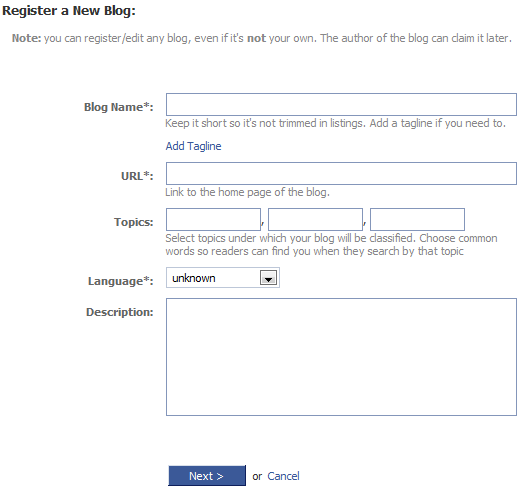
  • Click the button at the top “Register a Blog”.

    • Enter info about your blog (or the blog you want your friends/fans to see). The “Blog Name” is what your friends/fans will see prior to each post. It should be descriptive but not too long.
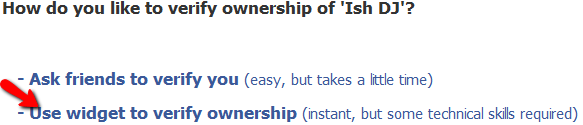
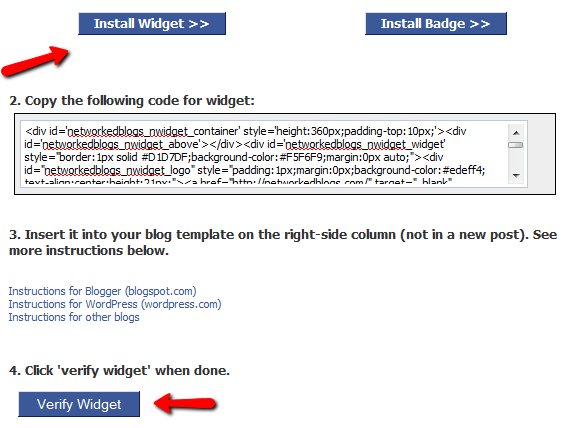
    • Click Next and then click yes to verify that you are the owner of the blog. The quickest way to verify this is to copy the code they will give you (click on “Use widget to verify ownership”) and place it in a sidebar widget of your blog. You can use any html widget to do this and can remove it from your blog once ownership is verified. Once the code is on your site, click the “Verify Widget” button on the Networked Blogs page.
  • Once this process is complete and your blog is added, you will need to set up automatic importing of your posts.
    • In the upper right corner of the application, you’ll see a link for “Syndication”. Click this and then choose your blog in the drop down box.
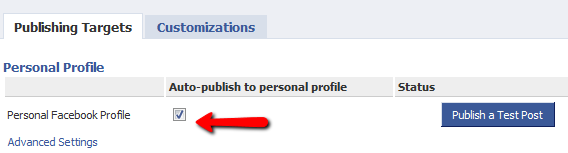
    • Check the box “Personal Facebook Profile” if you want blog posts to be seen on your personal wall & news feed.
    • If you are the administrator of any pages, you will see these listed. Click “Configure” for any page(s) you want the feed to appear on. You may need to click the “Install” button to add the application to that page. Then check the box “Auto-Publish blog posts to Page Wall” and you’ll be good to go!

Adding a blog via the Notes Application

  • There are 3 ways to get to the application:
    • Look for it on your tabs in your profile
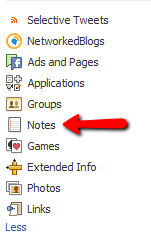
    • Look for it on the left sidebar in the applications area. You may need to click “See More” to see it listed.
    • In the search box, type “Notes” and it should come up – click on that link.
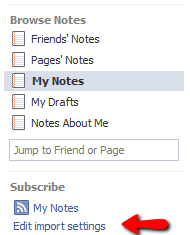
  • Once open, on the left sidebar, look for the text link that says “Edit Import Settings”
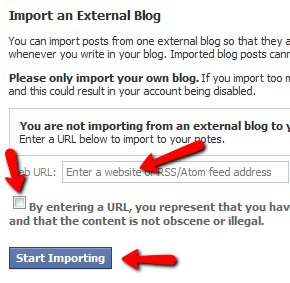
  • Enter your blog’s feed address in the box, check the agreement box and hit the “Start Importing” button. This may import *all* of your past blog posts, so just be aware. If you have a bunch then it could clog up the news feed on your Facebook wall.

Facebook for Business: Profile vs. Page vs. Group

Facebook for Business: Profile vs. Page vs. Group

Aug 19, 2010

Chances are, you have a Facebook account. It’s a great place to keep up with family and friends, or maybe a way to see the more personal side of clients or colleagues. As a business owner (especially if your customers are consumers), you may be realizing the value of having your company on Facebook too and building a following there. So you should probably create a separate Facebook account for your business, right?

Hold on! Before you create a second Facebook account or start using Facebook for business, there are a few very important things to know:

You can only have 1 Facebook Profile

Each individual may have 1 Facebook Profile (i.e. login). You cannot have a Facebook Profile for a business. Check out Facebook’s Terms of Service or FAQ on this subject if you want more information.

So what is a Facebook Profile? This is your main Facebook account, the one where you can accept people as “Friends”, post your vacation pictures, play games, and talk with your friends about… anything that you like. You can set your privacy settings so that only your Friends can view what you write on your wall, the comments you make to friends, the pictures you post, your personal contact information, etc. While many people do indeed post work related items on their profiles (I do frequently), your profile is really a place for you to be personal.

How do you use Facebook for business?

The way to get your business on Facebook is to create a Facebook Page. Although you have to create the page from your personal Profile, those who “Like” your Facebook Page won’t see anything from your personal Profile unless they’re already your Friends.

A Facebook Page is the place for you to talk about business. Anyone can connect with your page without seeing all your personal information and posts. Your connections can grow to unlimited numbers (the limit on your Profile is 5000 friends). Some things you can do on or with your Page:

  • Talk about what you do and the services you provide.
  • Give readers tips and tricks on your area of expertise.
  • Encourage contacts to sign up for your newsletter.
  • Run contests.
  • Conduct polls.
  • Start discussions and interact with those who Like your Page.
  • Create a custom landing tab where you educate new visitors about what you do or direct them to a special.
  • Update contacts quickly and easily (you can only message 20 people at a time via your personal Profile).
  • Create a Specials tab that only those who have “Liked” your Page can see.

A Page is like a website – anyone can visit and get information about your business. Your personal information and posts are protected unless you decide to Friend someone from the Page.

What about Facebook Groups?

Facebook Groups are designed more for groups of people with a common interest.  Things like a church group, participants in a class,  alumni of a college, etc. Groups can be private (only members see group activity) or public and you can choose to restrict/moderate membership. Groups can email up to 5000 members at a time but have limited functionality when it comes to customization and applications.

Here’s a great breakdown from Mari Smith on Pages vs. Groups.

Enhanced by Zemanta

Why Blog When You Have Facebook?

This is a great post by blog guru Denise Wakeman on why you should have a blog even if you’re an avid Facebook user. Great food for thought and a reminder that you need to back up your content, regardless of where it resides!

http://www.buildabetterblog.com/2009/07/why-blog-when-youve-got-facebook.html

10 Twitter Tips For Traditional Media

Attention, those in charge of online marketing for Media! You need to read this blog post from Steve Pratt:

10 Twitter Tips For Traditional Media

Steve’s first tip hit home – this is exactly what most of the media folks I follow on Twitter are doing! They are using it as an RSS Feed and not as an interaction tool. While there is some value in that, I can easily get that from the traditional RSS feed on their webpage. What I want from the media on Twitter is:

1. Some true breaking news (traffic accident on the Interstate, terroist attack, criminal loose in my area, etc.) – but not every news item that comes across their desk
2. Personal interaction! Ask about our thoughts & ideas, what’s newsworthy to us, what leads we might have for a story you’re doing (like HARO but more locally focused). Slow news day? We’ll have ideas for you! Need a witness to that accident? Bet they’re online.

Rick Sanchez at CNN gets it – he lets us know what stories he’s working on, asks for feedback and opinions, even reads some of the responses on air. There are others that get it too, but they’re few and far between. So, if you’re in media and are in the department responsible for your online presence on Twitter, Facebook, etc. – please move away from just listing what’s on your website already and start interacting with your readers & listeners. I promise you won’t regret it!

Social Networking: 7 Steps to More Traffic by Connecting and Repurposing Your Social Marketing

A very timely article from Online Marketing guru Donna Gunter. I’ll be talking about this very subject today in a local seminar for business owners. Stay tuned for information on a series of Social Media seminars in the Colorado Springs area!

I’m lazy by nature and like to do as little work as possible. Therefore, when I have the opportunity to automate tasks, I jump at it. As I started getting heavily involved in social networking, I quickly became frustrated with having to update my status at several sites, as well as trying to figure out how to introduce my blog, my articles, and my ezine to my social networking audiences.

After much trial and error, here’s how I connect and repurpose all of my social marketing strategies:

1. Set up accounts. Make sure that you have current accounts with Twitter, Facebook, Linkedin, MySpace, and any other social networking platforms you regularly use.

2. Open an account at Ping.fm. The Ping.fm service automatically updates your status on all of your social networking sites, 21 of them at the current count. Depending on the number of networks you use, it will take you 10-50 minutes to connect your Ping.fm account to your various social network accounts. However, once everything is set up, you simply log into your Ping account, post your status update (no more than 140 characters), and your status is automatically updated on all of your social networking profiles. Rather than posting updates directly on Twitter or Facebook or MySpace, I instead use Ping.fm as the starting place for my daily status updates.

3. Display Twitters on other accounts. If you go to your Setting tab in your Twitter account and then down to “More Info URL”, you will see a link to “Add Twitter to Your Site.” By clicking on this link, you’ll be taken to a page where you can add your tweets in a separate box (not the Status updates area) in your MySpace and Facebook profiles, on your blogger or Typepad blogs, or get the Flash or HTML widgets to add to other sites like Squidoo lenses or to your website. Just follow the instructions connected to each application. If you use Typepad for your blog, you can also do this through the Widget gallery by finding Twitter widget in the “Publishing Tools” section.

4. Connect your blogposts to Twitter. Twitter Feed enables you to feed your blog posts to your Twitter account. Simply create an account, go to “Create New Twitter Feed”, and enter the RSS feed of your blog. You can control the frequency with which Twitter displays your blog post, as well as the text used to preface your blog feed. I use “Blog update” to preface my posts.

5. Connect your blogposts to Facebook. I use Typepad for my blogs, so if you use a Wordpress blog, there are probably plugins that handle this, as well. When you create a new blog post, you can choose to send a link to that post into Facebook. These links will appear in your Mini-Feed on your Facebook profile, and may appear in your friends’ News Feeds.

In your Typepad account, go to Weblogs > Configure > Publicity, select “Prompt me to share new posts on Facebook.” When this item is selected, TypePad will automatically display a prompt from Facebook when you create and publish a new post on TypePad. The Facebook prompt will only appear if you have selected the option in your weblog’s publicity settings, and only when you create and publish a new post. The prompt will not appear when you save a post as draft, when you edit a post, or when you change the status of a post from Draft to Published.

6. Update your EzineArticles.com account. Article marketing is a smart and easy way to drive traffic to your site. If you’re submitting articles online to article directories, you definitely want to be using EzineArticles.com, the biggest and most popular article directory online. To connect to Twitter, click on “Profile Manager” in your account, then “Edit Author Bio” in your Author’s Area. Add your Twitter account information here. Each time a new article is accepted and published at EzineArticles, a post is automatically made to your Twitter account.

7. Update your aWeber account: I use aWeber as my email marketing service. You can now send an automatic Twitter post to all your followers on Twitter with a link to the HTML version of your ezine. When you create a broadcast in aWeber, select the option to publish a broadcast via RSS feed or to an archive, and then enter your Twitter account info, When your ezine is published, all of your Twitter followers will be notified.

There are probably others ways to connect the social networks and to repurpose content on social networks, but these 7 steps are all I need at the moment. Take 30 minutes out of your day to connect and repurpose your social networking, and watch your traffic and list begin to grow!

Online Business Resource Queen (TM) and Online Business Coach Donna Gunter helps independent service professionals learn how to automate their businesses, leverage their expertise on the Internet, and get more clients online. To claim your FR*EE gift, TurboCharge Your Online Marketing Toolkit, visit her site at OnlineBizU.com. Ask Donna an Internet Marketing question at AskDonnaGunter.com.